 |
| Hand woven Shetland roving rug, natural colors A few years ago, a friend loaned me a little child's loom. It would weave about 5 inches width-- but through those 5 inches, I fell down the rabbit hole! I need a bigger loom, I said. New ones were pricey but there was an antique one in pieces. You know which one I chose.  Now that it's home, how do I assemble it with no instructions?? Internet not helpful--- off to the library! Found an old weaving book with pictures:   Have been weaving ever since! Scarves, shawls, table runners, dish towels, a baby blanket and soft, squishy rugs. Meanwhile, the sheep just keep making wool.    some recent wool rugs:    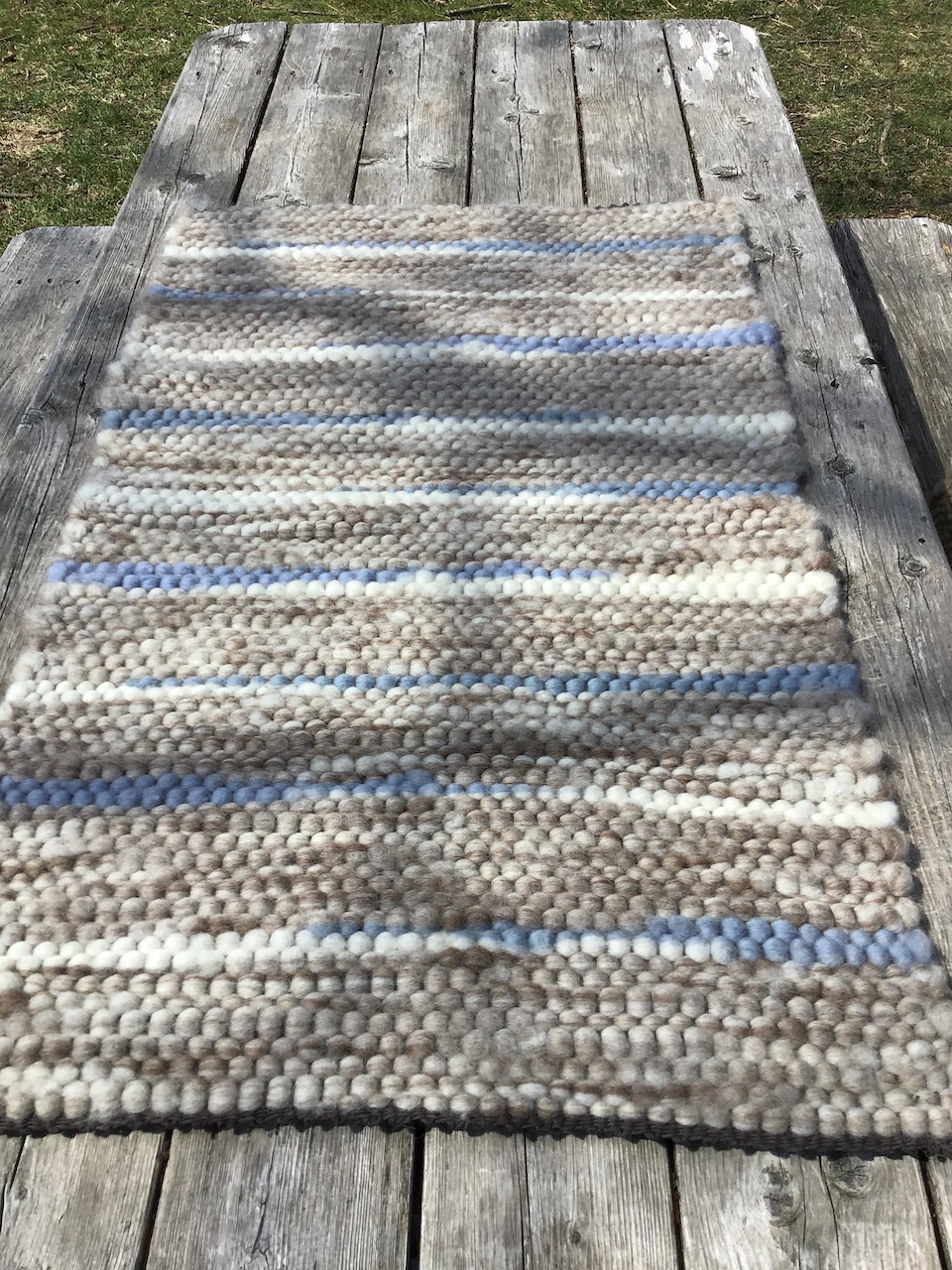  Rugs available in my Etsy shop! |
Showing posts with label Shetland. Show all posts
Showing posts with label Shetland. Show all posts
Weaving rugs 2021
A Tale of Woad II: more dyeing summer 2020
 |
| The Blue Froth!!! |
Had so many plants last summer,
I moved the dyeing outside
and
invited fiber friends to come share the bounty.
I was able to dye multiple batches of washed fleece and yarn.
The woad kept growing back!

 |
| torn up leaves, ready to go! |
 |
| poured boiling water over & let it steep |
 |
| A friend enjoys the magic moment when the yarn turns from green to blue |
 |
| turning from green to blue |
 |
| blue fleece drying |

 |
| shades of blue |
Plenty of blue roving to spin and for weaving into rugs.
 |
| wool rug with natural colors and woad blue accents |
A Tale of Woad : small scale dyeing tutorial
I planted woad in my garden a few years ago.
It's a scruffy plant, not much to look at.
Maybe it's my imagination,
but it seems that the leaves
already have a blueish tint.
but it seems that the leaves
already have a blueish tint.
And if you pinch a leaf, a little blue bruise appears.
 |
| needs a plant marker saying "I AM NOT A Weed" |
Woad, used in tapestries and textiles in centuries past,
is a rare source of indigo dye that can be grown this far north.
The dye process can be (ahem) unpleasant, involving
certain bodily fluids (or chemicals), and strange odors**
...but the color lasts for centuries!!
In the old tapestries,woad blue wool
was often overdyed
with yellow dye (from weld plants)
to make: Green.
As the years passed, the yellow has faded,
and some lovely ladies,
flowers,
and unicorns
have been left standing
in fields of Blue.
In the old tapestries,woad blue wool
was often overdyed
with yellow dye (from weld plants)
to make: Green.
As the years passed, the yellow has faded,
and some lovely ladies,
flowers,
and unicorns
have been left standing
in fields of Blue.
When I first started playing with natural dyes back in the 1990's,
I quickly tired of tans, golds and yellows.
I tried a recipe for 'copper penny blue'
but alas, it was not lightfast.
Decades later, my blue yarn
has faded completely
back to white:
 |
| crewel yarn dyed with dyers coreopsis, mullein and copper pennies |
Before aniline dyes were developed, if you wanted a lightfast blue,
you had to use imported indigo or extract the indigo from woad.
Woad contains the same dye chemical, just at a lesser concentration.
So a few years ago, I revisited natural dyeing,
and out of curiosity, I grew some woad here in Maine.
My first dyeing attempt yielded
a still-white silk scarf, unchanged
but for a barest whisper
of grey-blue. : (
The second year, I got a definite grey-blue;
took lots of notes and
saved seeds for another try.
 |
| Woad dyed silk scarf & mill-spun Shetland wool |
Last year, following the same procedure, the blue was bluer
but I have no idea why.
The joy of natural dyeing!
 |
| Woad dyed handspun Shetland singles & mill-spun 2 ply |
 |
| handspun Shetland crewel yarns: blue (woad), natural moorit brown, moorit/white blend; on linen |
Small Scale Dyeing with Woad:
You will need:
-first year woad plants (second year it goes to seed)
-Dyeing pots/utensils (not used for food ever again)
-RIT color remover (fresh) (craft store)
-Washing soda (the Woolery or Dharma trading)
-paper towels, paper plates, colander
-wool
1. Pick leaves. Tear them up and toss into a bowl.
( I used leaves from 5 small plants (~8 oz) on ~2 ounces of fiber, a 4:1 ratio plant:fiber when I got grey blue; I used only 3 plants and a 2:1 ratio when I got the bluer blue! Go figure. Or maybe not. )
Pour boiling water over the leaves (just enough to cover). Let steep as it cools for about 1 hour.


3. Cool completely to lukewarm (120 degrees F).
Stir in 1 1/2 T washing soda, enough to make the liquid turn greenish brown.
 |
| Greenish liquid on spatula. Using white utensils & containers really helps! |
4. Aerate the liquid by pouring back and forth between 2 containers. I used 2 quart-sized yogurt cups.
Make sure you are getting BLUE Froth. Add more washing soda if needed.
 |
| Aerating (adding oxygen into the liquid) |
 |
| we have Blue Froth!! |
Avoid making any bubbles from this point on!
6. Remove pot from heat, let stand 1 hour. Meanwhile, presoak your fiber in warm water.
7. Add fiber, gently. Let stand quietly for about 20 minutes. (no bubbles!!) The fiber will look green in the pot.
8. Time for the Magic to Happen: Remove fiber gently and lay it on a paper plate. Leave exposed to the air for at least 20 minutes. The green fiber will magically convert to BLUE as you pull it out of the pot Before Your Very Eyes!! Enjoy!
 |
| Green fiber in the pot, turning Blue on the plate! |
You can cover your dyepot
And keep it overnight
for more dyeing tomorrow....
BUT
you won't WANT to
cuz it smells like
**OLD CIGARS!!😝
Recipe for a wool filled quilt
 |
| Poppy and DeNozo |
1. Start with a few Shetland sheep. Add green grass and sunshine.
2. Stir in some late summer apples.
 |
| they love apples! |
3. Add generous amounts of hay during the long Maine winter.
 |
| waiting for spring |
4. Shear in the springtime!
 |
| Gibbs' fleece |
 |
| DeNozo and Gibbs after shearing |
5. Gently wash the fleece by hand in buckets, spread out in the sun to dry.
 |
| a good drying day |
6. Clean the fleece by picking and then carding into fluffy batts.
 |
| drum carder ready to roll |
 |
| batt weighing in |
 |
| Stash of batts |
7. Spread out cotton fabric on a table, and layer the wool batts over the cotton.
 |
| unbleached muslin & wool |
8. Lay the top fabric piece over the wool, measure and tie by hand.
 |
 |
| tying a small muslin lap quilt |
9. Finish the edges.
 |
| I use a 1919 Singer treadle machine! |
10. Ready for a little nap!
 |
| small muslin lap quilt, or "nap quilt" |
Subscribe to:
Posts (Atom)